
CCMS or DMS: What are the differences and which solution should you choose for your technical documentation?

A DMS and a CCMS both centralize information, but they operate at different levels. The DMS primarily manages complete documents or files. The CCMS manages the structured components that make up those documents: a procedure, a warning, a description, a table, or an illustration, for example.

For simple technical documentation with few variants and primarily office-based content, a DMS may suffice. As soon as the same information must be reused across multiple manuals, adapted to different configurations, translated, and published across multiple channels, the CCMS becomes more relevant. In many organizations, the two systems are complementary.

DMS, CCMS, ECM: What exactly are we talking about?

The acronyms look similar and functional boundaries evolve with software. To compare solutions, we must therefore start with the unit of information they manage and the business process they serve.

A multi-page document managed as a single unit

Document Level

What is a DMS?

A document management system centralizes files and the information needed to find them, manage them, and control their lifecycle.

A DMS typically provides:

  • Common repository and classification by metadata
  • Document search and consultation
  • Versions and access rights
  • Approval workflows
  • Preservation and archiving of deliverables
Management UnitThe file or complete document
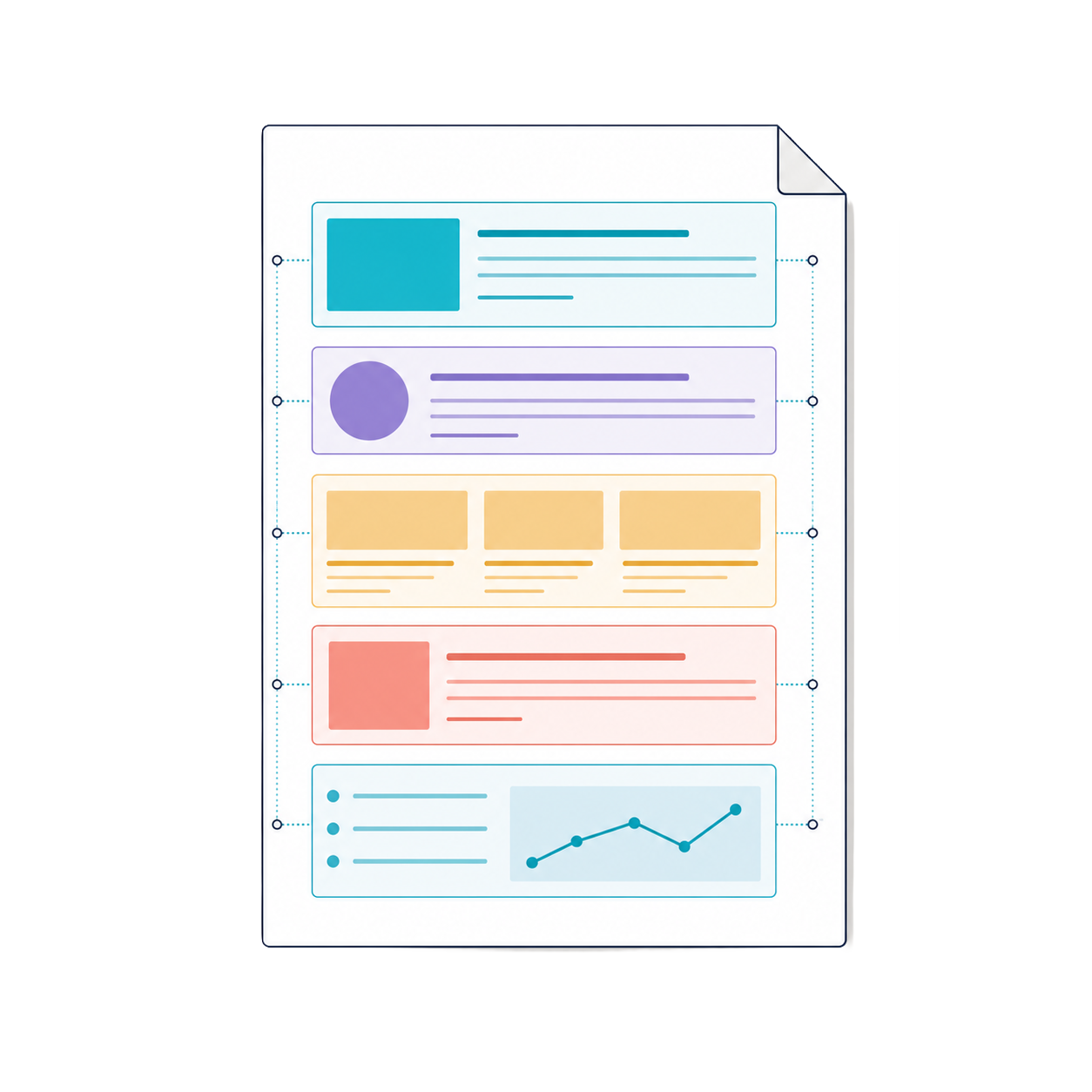
Autonomous topics assembled and reused across multiple publications

Component Level

What is a CCMS?

A Component Content Management System manages the structured information units used to build, adapt, and publish documentation.

A CCMS typically provides:

  • Authoring and validation of structured content
  • Versions, statuses, and dependencies
  • Reuse across multiple publications
  • Variants, products, and user profiles
  • Source and translation tracking
  • PDF, web, portal, or application publishing
Management UnitThe reusable content component

Key takeaway: the DMS primarily answers "Where is the right document?" The CCMS also answers "What is the right information to include in each version of the document?"

And where does ECM fit in?

Enterprise Content Management, or ECM, covers a broader scope of enterprise content management. An ECM platform can centralize structured and semi-structured content, orchestrate workflows, manage rights, connect multiple sources, and feed different channels.

Depending on its configuration, an ECM platform can therefore support advanced DMS uses, knowledge management, or business document applications. However, it does not automatically become a CCMS: the content model, structured authoring functions, versioning granularity, and publishing chain remain decisive.

CCMS vs DMS: The Essential Differences

DMS

A document composed of multiple pages is managed as a unit.

CCMS

Autonomous components are reused and assembled as needed.

Functional comparison between a DMS and a CCMS
CriterionDMSCCMS
Managed UnitFile or complete documentStructured content component
PurposeClassify, find, share, and preserveCreate, reuse, assemble, and publish
Common FormatsPDF, Word, images, drawings, and office filesXML and other structured content, with their media
ReuseFile sharing or copyingSame source component across multiple deliverables
VariantsSeparate document versionsConditions, metadata, and targeted assemblies
TranslationManagement of translated filesTracking at component and source version level
PublishingDistribution of existing filesPDF, web, portal, or application generation
Typical UseContracts, reports, procedures, and quality recordsProduct manuals, online help, and maintenance documentation

Two complementary approaches: a CCMS can produce and maintain technical information, while a DMS preserves and distributes approved deliverables.

When is a DMS sufficient for technical documentation?

A DMS remains suitable when documentation primarily consists of standalone files and internal reuse remains limited.
It may suffice if:
  • the number of manuals and variants is low;
  • documents are produced in Word, Excel, a CAD or DTP tool, then distributed as PDF;
  • updates apply to entire documents;
  • each file has few variations by product, market, or language;
  • the priority objective is to centralize, secure, and retrieve deliverables;
  • multi-channel publishing requirements remain simple.

Example: a quality department must manage reports, approved forms, and internal procedures with limited reuse. The priority is to find the latest validated version, control access, and maintain history. A properly structured DMS can meet the need without requiring a complete transformation of the editorial chain.

When should you consider a CCMS?

The tipping point appears when the main cost no longer lies in storing the final document, but in producing, updating, and adapting its content.

01

Duplicated Content

The same information is copied across many manuals.

02

Repeated Corrections

Each change must be manually replicated in multiple places.

03

Numerous Variants

Products, options, and configurations multiply the versions to maintain.

04

Massive Translations

Entire documents are translated or verified after each change.

05

Multiple Contributors

Several teams contribute according to different roles and workflows.

06

Multi-Channel Publishing

Deliverables must exist in PDF, HTML, portal, or application formats.

07

Fine-Grained Traceability

You need to find an instruction across all publications that use it.

08

Difficult-to-Maintain Files

The volume and frequency of updates exceed current methods.

Correct each file
The same information exists in multiple documents, versions, and languages.
Maintain the source once
The validated component is reused in each publication to which it applies.

Can DMS and CCMS work together?

Yes, and their roles are often complementary. Confusing them or systematically trying to replace one with the other can unnecessarily expand the project.

A Document Chain, Four Responsibilities

From structured source to accessed information

  1. CCMS

    Creates, validates, and maintains structured sources and their variants.

    Editorial components
  2. Publishing

    Assembles content and generates manuals, web pages, or application content.

    Multi-channel deliverables
  3. DMS

    Preserves and distributes approved deliverables with other project documents.

    Document package
  4. Portal

    Gives each user access tailored to their rights and context.

    Access point
CCMS source of truth
The structured and reusable editorial component
DMS source of truth
The approved document package or contractual deliverable

The critical point lies in the exchanges: connectors, identifiers, metadata, and synchronization rules must be defined from the design phase.

Decision Support Grid

Eight Questions to Ask Before Choosing

These questions help evaluate the granularity, reuse, distribution channels, and transformation effort actually required.

Theme 01

Content and Granularity

  1. 01

    What is our actual update unit?

    Do we update a complete file or information shared across multiple publications? This question quickly reveals the necessary level of granularity.

  2. 02

    How many times is the same content duplicated?

    An audit of a sample of manuals can identify repeated procedures, warnings, specifications, and illustrations. The greater the duplication, the more value component-based reuse can create.

Theme 02

Variants and Translation

  1. 03

    How many variants must be maintained?

    Products, options, software versions, countries, user profiles, and contracts create combinations. You must verify how the solution expresses applicability and prevents inconsistent assemblies.

  2. 04

    How is content translated?

    Should a minor change trigger retranslation of an entire document? Component-level tracking can limit volumes sent for translation, provided architecture and workflows are rigorous.

Theme 03

Distribution and Traceability

  1. 05

    Which publishing channels are required?

    A single PDF does not impose the same requirements as simultaneous production to PDF, HTML, a knowledge base, and a mobile application. You must test real deliverables, including tables, warnings, illustrations, and conditional content.

  2. 06

    What levels of traceability are expected?

    Does the need concern a file's history or each component, its author, status, version, translations, and publications?

Theme 04

Integration and Organization

  1. 07

    Which systems must the solution interact with?

    PLM, ERP, translation tool, IAM, DAM, portal, search engine, and publishing tools must be included in the scoping. An isolated system demonstration is not sufficient to validate its integration into the information system.

  2. 08

    Is the organization ready to evolve its methods?

    A CCMS requires a content model, authoring rules, responsibilities, metadata governance, and contributor support. The expected gain depends as much on these choices as on the software.

The right solution is derived first from the process to be equipped. The answers reveal the level of granularity, integration, and change management required—even before comparing software.

How do you move from file management to component management?

Migration does not mean automatically converting all existing files to XML. A progressive approach allows you to focus effort where components truly create value.

Starting PointFile Management
TargetComponent Management
01
Understand

Diagnose

  1. 01

    Define objectives

    Identify families where duplicates, variants, and translations are most costly.

  2. 02

    Audit content

    Measure its quality, formats, redundancy, and dependencies.

02
Prepare

Design and test

  1. 03

    Design the model

    Define components, metadata, reuse rules, and target publications.

  2. 04

    Test a representative scope

    Choose a product with real variants, without selecting the most complex case.

03
Sustain

Deploy sustainably

  1. 05

    Organize governance

    Assign roles of author, reviewer, owner, translator, and publication manager.

  2. 06

    Industrialize migration

    Automate what can be automated, then verify the structure and meaning of migrated content.

  3. 07

    Measure results

    Track timelines, reuse, translated volumes, and publication anomalies.

The real objective is not to "do XML." It is to have information that is easier to maintain, control, and publish.

Frequently Asked Questions About CCMS and DMS

The CCMS primarily replaces a production chain centered on files. The authoring interface can remain visual and hide the complexity of markup. Word documents can also remain for content that does not justify structured management.

No. DITA is a widely used standard for modular technical content, but some CCMS support other XML schemas or proprietary models. The choice depends on interoperability, specialization, and publishing requirements.

It can share a source file or avoid certain duplicates. However, without additional functions, it rarely offers the granularity and assembly mechanisms required for advanced component-level single sourcing.

You must compare the project cost to gains in updates, reuse, translation, publishing, quality control, and error handling. Document volume alone is not sufficient: the frequency of changes and the number of variants are often more decisive.

Start with a targeted audit of content and processes. It will determine whether the problem concerns document classification, component-based production, or both.

A DMS is primarily designed to manage documents. A CCMS is designed to manage the reusable information that composes them. This simple difference has direct consequences on updates, variants, translation, traceability, and multi-channel publishing.

Before comparing feature lists, observe your actual chain: where does information originate, how many times is it copied, who validates it, where is it published, and how do you know it is current? It is from these answers that you can build an appropriate document architecture.

Technical documents analyzed then transformed into structured components and multi-channel publications

Consulting and Support

Is your documentation multiplying faster than your teams can maintain it?

4D CONCEPT experts can analyze your content, processes, and publishing objectives to identify the most suitable architecture and HEYSQUID modules.

Discover HEYSQUID and request a demonstration

Further Reading

Useful References

A selection of institutional and normative resources to deepen understanding of DMS, digital document management, and component-based structured content.

01
Document Management

IEC 82045-1:2001

Principles and methods for defining metadata and managing documents throughout their lifecycle, particularly in electronic document management systems.

View standard ↗
02
Records Management

ISO 15489-1:2016

Reference principles and concepts for creating, capturing, and managing records, regardless of their format and technological environment.

View reference ↗
03
Software Requirements

ISO 16175-1:2020

Functional requirements model and recommendations applicable to software that manages digital records.

View reference ↗
04
Component Content

OASIS — DITA 1.3

Reference specification for authoring and organizing topic-oriented information, its assembly, and reuse across multiple deliverables.

View reference ↗

Note: these references describe principles and standards. The choice of a solution must always be based on evaluation of its actual capabilities, content model, and integration into the information system.

Our offerings

At 4D CONCEPT, we provide support for companies in the creation, optimization, and management of their documentary content, regardless of their industry. Whether you need to audit your existing documentation, outsource technical content production, or train your teams, our solutions adapt to every stage of your project.
Explore how our documentation engineering services can meet your specific needs.

Accueil : ingénierie documentaire - 4D concept map 20 CCMS 5

Paris

41 avenue du Centre
78180 Montigny-le-Bretonneux
SAINT-QUENTIN-EN-YVELINES

Accueil : ingénierie documentaire - 4D concept map 20 CCMS 5

Toulouse

76 Voie du Toec
L’ECLAT Building – 3rd floor
31300 TOULOUSE

Accueil : ingénierie documentaire - 4D concept map 20 CCMS 5

Lyon

523 cours du 3ème Millénaire
Building D – 1st floor
69800 SAINT-PRIEST

Accueil : ingénierie documentaire - 4D concept map 20 CCMS 5

Aix-en-Provence

Espace Town
3120 route d’Avignon
13090 AIX-EN-PROVENCE

Accueil : ingénierie documentaire - 4D concept circle info 16 CCMS 9

Stay informed about 4D CONCEPT news

You confirm that you have read our privacy policy. You may unsubscribe at any time by contacting us at dpo@.4dconcept.fr

*By submitting this registration form, I agree that the information entered may be used by 4D CONCEPT to send me newsletters
Accueil : ingénierie documentaire - 4D concept phone 16 CCMS 10

Main Phone:

+33 (0)1 61 08 50 20

Accueil : ingénierie documentaire - 4D concept Envelope CCMS 11

Email:

Legal NoticePrivacy Policy – All rights reserved – 4D CONCEPT – 2026