


S1000D: Understanding Data Modules, DMRL, and the Publication Cycle
Documentation standard · information architecture
From Page to Data Module
S1000D organizes technical documentation around autonomous, identified information units. Each module can be controlled, updated, and reused, then assembled into a publication tailored to a configuration, mission, or user profile.
01 · Principle
What Is an S1000D Data Module?
Information That Can Stand Alone
A data module addresses a coherent subject: description, procedure, troubleshooting, maintenance information, or illustrated data. It has its own identity and status.
This modular approach enables targeted updates without revising an entire manual.
Identification & Status
DMC, title, language, issue, security, applicability, dates, and responsibility.
Content
Structured text, steps, warnings, tables, references, and media.
Controls
Structure rules, BREX, business quality, and approval workflow.
02 · Identifier
How to Read a DMC?
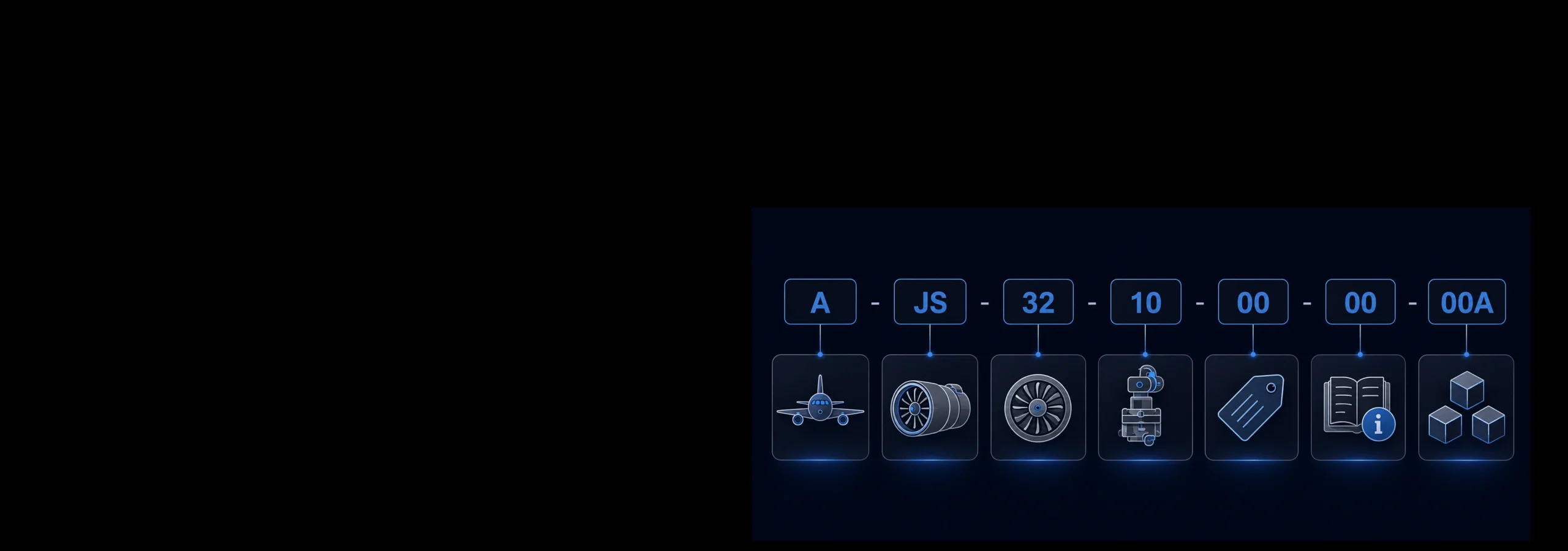
The Data Module Code is the structured identifier of the module. Its construction reflects the product, its breakdown, the nature of the information, and its variant. The exact segments depend on the identification model defined by the program.
Key point: the DMC does not replace metadata. It ensures identification; applicability, status, and security remain explicitly managed.
03 · Governance
What Is the Purpose of the DMRL?
The Data Management Requirements List is the registry of modules expected by the project. It defines the scope, distributes production, and tracks data maturity.
- Which modules must exist?
- Who produces and validates them?
- For which deadline and deliverable?
- With which applicability rules?
04 · Lifecycle
From Documentation Requirement to Published Information
A modification does not automatically become applicable. Its impact must be analyzed, the new issue approved, and the affected publications regenerated in a controlled manner.
05 · CSDB and Distribution
A Governed Source, Multiple Forms of Access
The Common Source DataBase stores and links modules, illustrations, publication lists, and control information. S1000D describes the data and their exchanges; it does not prescribe all CSDB software functions on its own.
CSDB
Paginated publication
Interactive navigation
Search and profiles
06 · Implementation
Decisions to Make Before Production
Adapt the specification to the contract and program.
Define products, variants, series, and conditions.
Automate project-specific controls.
Assign authors, experts, approvers, and owners.
Choose formats, conventions, and reuse rules.
Prioritize the reuse of high-value content.
Success is not measured by the number of XML files converted, but by the reliability of applicable information, the update turnaround time, and the ability to produce the expected deliverables.
Frequently Asked Questions
What Needs to Be Clarified
Does S1000D require a specific tool?
No. The specification primarily defines models, rules, and data exchanges. The choice of tooling depends on volume, workflows, interfaces, and the program's security requirements.
Does a module correspond to a page?
No. A module is a logical unit of information. Its length and presentation vary depending on the subject and publication channel.
Must everything be migrated from the start?
No. A representative pilot scope validates the model, rules, publication, and governance before a phased migration.
Are DMRL and table of contents equivalent?
No. The DMRL governs the data expected by the program. A publication then assembles an organized selection of modules.
Official References
Reference Sources
- S1000D Council — Getting started with S1000D: data modules, identification, and CSDB.
- ASD/AIA S-Series — About S1000D: scope, uses, and publications.
- S1000D.org: governance and official specification resources.
Consulting and Support
Transforming S1000D into an Operational Documentation Chain
4D CONCEPT experts can help you define Business Rules, build the DMRL, organize content migration, and industrialize publications with ADAM S1000D.
Discover ADAM SUITEOur offerings
At 4D CONCEPT, we provide support for companies in the creation, optimization, and management of their documentary content, regardless of their industry. Whether you need to audit your existing documentation, outsource technical content production, or train your teams, our solutions adapt to every stage of your project.
Explore how our documentation engineering services can meet your specific needs.

Request for general information
Contact us to get information about our solutions and services.
Request a demo
Contact us to schedule a demo.
Learn more about our training courses.
Book or request information about our training courses.
Request for general information
Contact us to get information about our solutions and services.
Request a demo
Contact us to schedule a demo.
Learn more about our training courses.
Book or request information about our training courses.

Paris
41 avenue du Centre
78180 Montigny-le-Bretonneux
SAINT-QUENTIN-EN-YVELINES
Toulouse
76 Voie du Toec
L’ECLAT Building – 3rd floor
31300 TOULOUSE
Lyon
523 cours du 3ème Millénaire
Building D – 1st floor
69800 SAINT-PRIEST
Aix-en-Provence
Espace Town
3120 route d’Avignon
13090 AIX-EN-PROVENCE

Stay informed about 4D CONCEPT news
You confirm that you have read our privacy policy. You may unsubscribe at any time by contacting us at dpo@.4dconcept.fr

Main Phone:
+33 (0)1 61 08 50 20

Email:

Professional equality index

91/100
Choose the website language:


Legal Notice – Privacy Policy – All rights reserved – 4D CONCEPT – 2026